From Granary to the Parish Church
Architecture
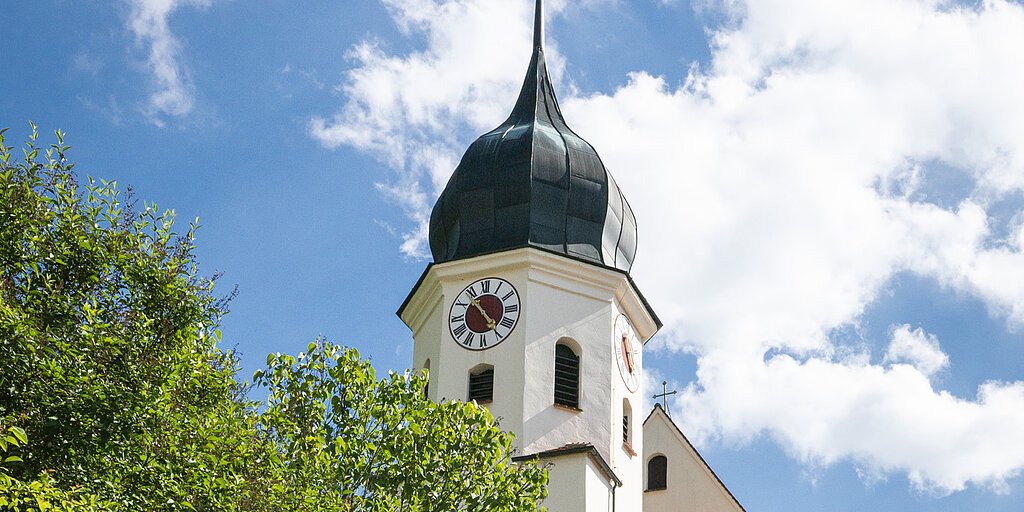
Kipfenberg's main Catholic church, the Church of the Assumption of Mary, stands on a picturesque hillside, below the castle and above the market square. Seen from below, the church and the castle above provide one of the most beautiful photo motifs in Kipfenberg. From the market square, you see the church’s full length, from the front on your left to the back of the church on your right. If you think the architecture is a bit odd, it is indeed. We have a relatively large and tall nave, a steep gabled roof, and a smaller extension to the left where the altar and sacristy are located. The side wall, facing the market square, is shared by a few rather small windows, with an entrance above a multi-step stone staircase. To the right, there is a short, high wall with a wrought-iron gateway through which one enters a small square at the gable end of the church. There, you find another entrance, above which, on several floors, there are what appear to be wooden doorways.
Kipfenberg Becomes a Parish
Kipfenberg was designated a parish in 1426, but there was no room for a large enough church within the town center. The small St. George's church, just outside the market gates, became the first parish church, but the parish grew rapidly and a more suitable place of worship had to be found. In 1881, Pastor Nikolaus Mayerhöfer described in his chronicle the solution to this problem and the reason for the church’s odd architecture. He wrote: "The money for a large church was certainly not available. One of the prince-bishops helped by giving the parish his granary at the foot of the castle for free, or at least for a small sum. After all, it was difficult to access anyway. This was converted into a church. A vaulted ceiling was not possible because the side walls would not have been able to withstand the pressure; consequently, a so-called coffered ceiling was installed, made of wood, painted with starfish, and secured with gilded strips. The windows were kept narrow so as not to weaken the wall. The eastern wall was breached and an arch inserted, to which the altar room, with its barrel-vaulted wooden ceiling, was attached, and the small tower, which houses the narrow sacristy, was built on this." So, our parish church was originally a granary, probably converted around 1426, shortly after Kipfenberg became a parish…which explains, of course, why the architecture of our church is so odd! And if you wondered about those doors above the rear entrance to the church, well, they were for hoisting sacks of grain in and out of the attics of the old granary! Two hundred years later, in 1624, a major renovation began, probably leaving little of the original furnishings intact. A stone plaque above the side entrance commemorates this renovation with the inscription "16.J.C.E.E.24," This stands for "Johannes Christophorus Episcopus Eystettensis, 1624". This refers to Johann Christoph von Westerstetten, Prince-Bishop of Eichstätt at the time. Since then, repeated renovations have been necessary. The bright and airy interior, which shines so splendidly today, stems from the most recent renovation, in 2012.
The Interior
On the inside, the central element is the magnificent high altar with the image of the Assumption of Mary, flanked by four columns on each side and statues of Saint Joseph and Saint Joachim. The altar, designed by the Eichstätt court sculptor, Matthias Seybold, was probably created between 1760 and 1765. Renovation work from 1767 is documented on the back of the altar. The two side altars were donated by local citizens. The altar on the left is dedicated to Saint Anne and features a painting depicting Saint Walburga and Saint Margaret. In front of, and below the painting, is a sculpture of a crescent moon Madonna, a particularly valuable piece created around 1500. The halo was added in 1951. The altar on the right, donated in 1768, is dedicated to Saint Sebastian. Sadly, the original painting from this altar has been lost. The current picture of St. Sebastian was painted by Ludwig Schnitzelbaumer in 1853. The church’s interior contains a number of other artistic and historical features you can see while visiting, or during a guided tour. A detailed church guide with a description of the sacred interior and with facts about the building's history, is available in the church and at the tourist information office. The church is open, and freely accessible during the day and during services.
vorherige Station nächste Station