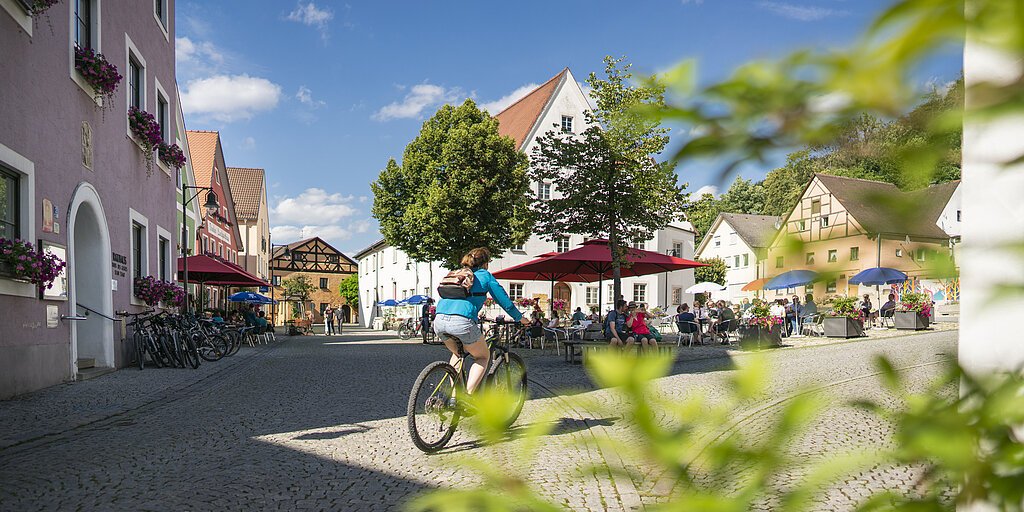
Welcome to the Center of Bavaria
Welcome to Kipfenberg, the market town at the geographical center of Bavaria. We begin with a few highlights of our history, a short version of a long history, so to speak. Additional background and further details will be presented in the units that follow. If you like, you can also book a guided tour of our town through the tourist information office. In 1972, a territorial reorganization of Bavaria, aimed at creating greater efficiency in local government, resulted in Kipfenberg becoming a municipality with 15 additional localities and a total of approximately 6,200 residents. When approaching Kipfenberg, the first thing most people notice is, of course, our beautiful castle, perched high above on a rocky outcrop. This is surely one of the most beautiful spots in the central Altmühl Valley, or in the Altmühltal, as we say in German. The 15 additional villages within the municipality of Kipfenberg are located upstream and downstream, in idyllic side valleys or on a plateau, together providing a diversity of beautiful landscapes. People have been living in and around Kipfenberg for a very long time, even long before the castle was built. The oldest archeological findings date from the Mesolithic period, from approximately 9500 to 6000 BC. More recent finds indicate the presence of settlers during the Bronze Age through to the Hallstatt period, dating from 1800 to 450 B.C.
The Romans in Kipfenberg
In the 2nd and 3rd centuries A.D., Kipfenberg and its surroundings were occupied by soldiers of the Roman Empire, for which we have a wealth of evidence. The Limes, a border fortification to defend against Germanic tribes, crossed the Altmühl River very close to our current bridge. For security and protection, soldiers were stationed in a small military camp near the present-day village of Böhming, just down the road when heading toward Eichstätt. The Roman period here in Kipfenberg was relatively short, ending in 233 A.D. when the Alemannen drove out the Roman army. About 300 years later, the Period of Migration had begun, and many tribal peoples were migrating throughout Europe. One of these groups, the Bajuwaren, settled here in Kipfenberg. The Bajuwaren would play a crucial role in shaping Bavarian identity and culture. The Romans had been driven from Kipfenberg in 233 A.D., but they were not far away. In fact, the Romans continued to control parts of Bavaria until their empire collapsed in 476 A.D. In 1990, near the road leading from here to Kinding, a remarkable grave was discovered. There lay buried The Warrior of Kemathen, as he has come to be called. The form of burial and the large grave with its diverse contents, tell us that he was a highly regarded Germanic warrior who had completed service as a mercenary in the Roman Army – possibly as an officer – before returning home. You can find the Warrior of Kemathen in a reconstruction of his grave and learn much more about the grave and its significance, in a unique exhibit in the Roman and Bajuwaren Museum, just next to our castle. The Limes Infopoint there also offers more comprehensive information about Roman border fortifications and about the Roman occupation of Kipfenberg and its surroundings. During construction of the Kipfenberg train station, which no longer exists, workers found another interesting burial ground, this one from the Merovingian period, dating from 400 to 700 AD. This discovery suggests that a larger settlement probably existed already back then, in what is now Böhming.
The Michelsberg
The Michelsberg is a 120-meter-high rock formation across from the castle, on the other side of the Birktal valley. Here are remnants of a fortification from the early Middle Ages. These have been thoroughly researched and documented. One document, from the year 908 A.D., reports that the Eichstätt bishop, Erchambold, was permitted to build a fortification here to defend against Hungarian invasions. This tells us that, even before they became rulers of our region as prince-bishops, the bishops of Eichstätt were seeking to secure their holdings in the Altmühl Valley. You can hear more about prince-bishops in the audio segment about our castle.
Kipfenberg becomes Bavarian
The name of our community first appears in a document from 1266 A.D., when a Rudegerus de Kipphenberc appeared as a witness in court. Later, in 1301 A.D., the Knight Konrad Kropf, lord of the castle, sold both the castle and the village below to the Bishop of Eichstätt. Thus, Kipfenberg had a new ruler, and the Bishops of Eichstätt continued to reign until 1803, when, with the secularization of Bavaria, church properties passed to the Bavarian state…and Kipfenberg became Bavarian...
Text: Werner Kränzlein, December 16, 2024
English Translation: Eric Geiger, August 2025
Speaker: Eric Geiger
Production: Landvilla-Audio Kipfenberg
With the kind support of Dr. Karl Heinz Rieder, District Heritage Officer and Scientific Director of the Kipfenberg Roman and Bajuwaren Museum
Sources:
Rieder, Karl Heinz: „Kipfenberg Römer und Bajuwaren im Altmühltal“ (Kipfenberg Romans and Bajuwarii in the Altmühl Valley), Verlag (Publisher) Friedrich Pustet Regensburg, 2020
Ettle, Elmar: „Rund um Kipfenberg“ (Kipfenberg and Surroundings), im Selbstverlag (Self-publsihed) Elmar und Christl Ettle, 1993
nächste Station