Kipenberg's Medieval Landmark
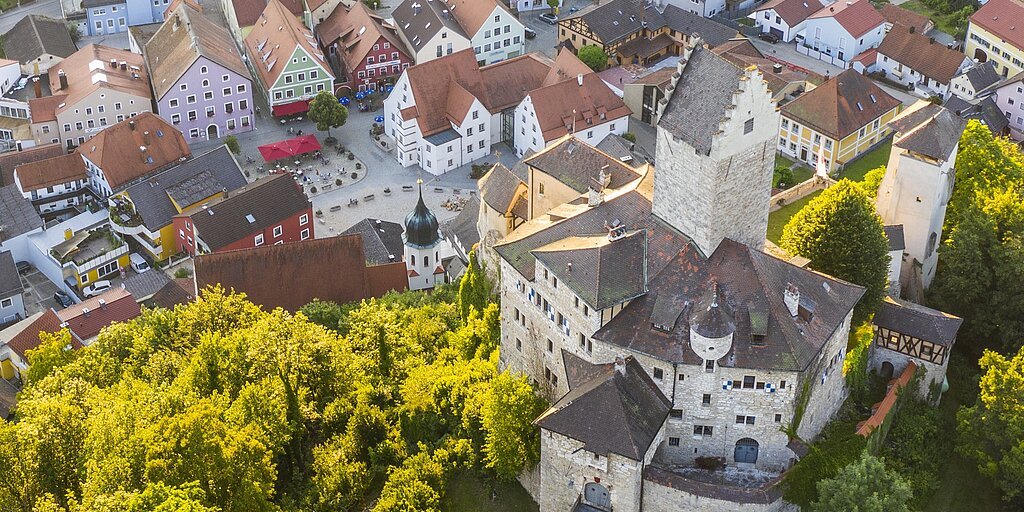
Our castle is just how we imagine a knight’s castle to be: perched on a rocky peak above a small town, visible from afar, a towering keep with stepped gable within a surrounding wall, a moat carved deep into rock, and, finally, a wooden drawbridge crossing the moat and leading to the main gate and inner courtyard…yes indeed, just as we imagine a knight’s castle to be! The most striking feature of our castle is its main tower, or “keep”, with its stepped gable. The last refuge in case of an attack, the keep rises from roughly the middle of the complex and looms above the rest of the castle. The surrounding structure and inner walls were constructed with so-called "Buckelquader", which are blocks cut from stone with a characteristic hump, or curvature, on the outward surface. These stones tell us that the castle was built around 1200 AD.
The First Document
The name Kipfenberg is first mentioned in a document from 1266. A Rudegerus de Kipphenberc was a witness in a court case. Rudegerus was presumably the steward of the castle, but who was the lord of the castle back then? Sources point to imperial ministers known as the Kropfs, or in Latin, Struma, of Emetzheim and Flüglingen, villages in the Weissenburg area, roughly 50 kilometers to the west of Kipfenberg. Only the last generation of owners actually lived here in their castle. A knight by the name of Konrad Kropf the Younger and his wife, Petrissa, began in 1277 to use the Kipfenberg coat of arms, which bears the Kipfstock still seen today in Kipfenberg’s official emblem. On September 1, 1301, Konrad and his wife sold the castle, together with the town of Kipfenberg, to the Prince-Bishop of Eichstätt, Konrad II of Pfeffenhausen. You may be wondering what a prince-bishop is. Well, these men were powerful religious and political figures in the Holy Roman Empire, which was established in 800 A.D. and lasted approximately 1,000 years! As the name suggests, prince-bishops were bishops with both ecclesiastical authority and secular authority over territories known as prince-bishoprics. They governed land, collected taxes, and even commanded armies, while also fulfilling their religious duties.
Under the Bishops
Getting back to our castle, the Prinz-Bishop's guardian, or "Pfleger” as he was called in German, moved into the castle shortly after Konrad II bought it in 1301. The “Pfleger” had wide-ranging responsibilities. He was something like a custodian, district administrator, mayor, and district judge - all rolled into one. Our castle remained in the possession of Eichstätt’s Prince-Bishops for about 500 years. Then, in 1803, in what is known as the “Napoleanic Secularization”, church property was confiscated by the state, and our castle became the property of the Grand Duke of Tuscany. Just three years later, in 1806, the Kingdom of Bavaria became the castle’s new owner. In time, the castle fell into private hands and was sold in parts. So-called "lesser folk" took up residence in various buildings belonging to the castle, but the castle began to decay. In 1836, the Bavarian state bought back the keep, or tower, thereby ensuring that at least it would be preserved. Just a few decades later, the castle was so dilapidated that, by order of the royal Bavarian government, all dwellings were evacuated and the castle became a ruin.
Reconstruction
In addition to the towers we still see today, the castle chapel on the western part of the hilltop has also survived. Except for the main tower, or keep, which remained in state ownership, the rest of the castle was acquired in 1895 by a private owner from Munich, Franz Häußler. In 1914, the widow of a pharmacist and factory owner from Berlin, Anna Taeschner, acquired the entire castle complex. She commissioned the then well-known castle architect, Bodo Ebhardt, to rebuild the castle. Her intention was not to restore it to its original architecture, but to create a contemporary home, with old and new structures, that met her family's needs, while still maintaining the spirit of the castle. So, although the castle complex no longer looks to us the same as it did to the Knights and Prince-Bishops who were here, the spirit of those times survives. The castle is still privately owned and cannot be visited; however, the owners have made the large outbuilding in the forecourt available for our Roman and Bavarian Museum. In this way, part of the castle complex does remain open to the public. Once each year, as part of our Roter-Rucksack Discovery Tours, you can access the castle courtyard. There, you can see up-close the drawbridge to the castle’s main entrance and various architectural elements, including the Buckelquaders, or curved blocks of stone, from around 1200 A.D. And the view of the valley is spectacular!
An especially impressive photo of the castle can be taken from the so-called Kipfenberger Brandplatz (Kipfenberg Fire Site). You can reach it on hiking trail no. 3 (the Kressensteig).
Wanderweg Nr. 3 (Kressensteig)