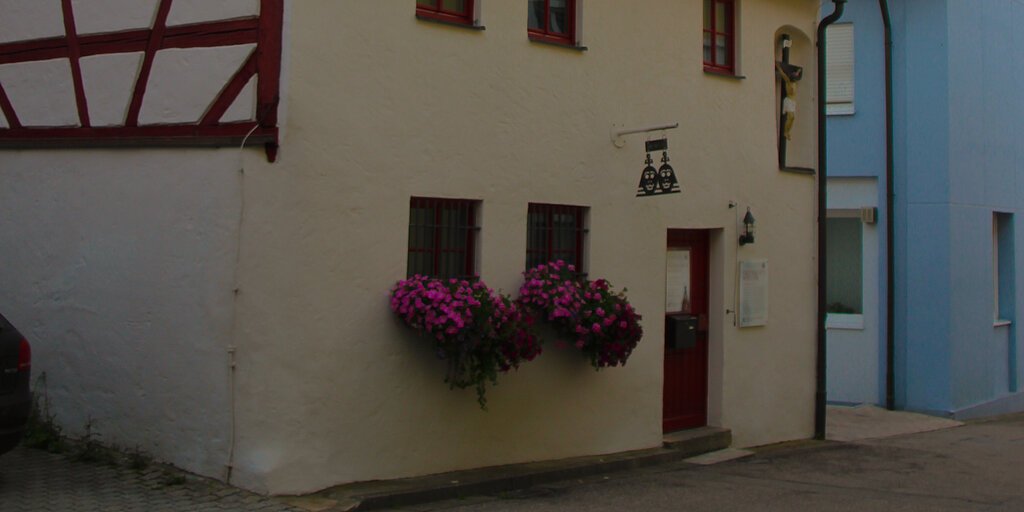
Former Gatekeeper's House at the Beilngries Gate
The Location
Kipfenberg’s Fasenickl Museum is located in what used to be the gatekeeper’s home, at the Beilngries Gate of the medieval city wall. Back then, the Beilngries Gate and an Eichstätt Gate were the only entrances to the town square. A third entrance, next to the Limes Inn, was created much later, in the 19th century, to secure access to the market square from the North. When walking from the Frankenring, past the Sparkasse on your right and toward the market square, the gatekeeper's house is located on the right side of the narrow lane called the Torbäckgäßchen. “Tor” for gate and “Bäck” for baker, the “baker at the gate” was located where the bakehouse behind Café Bauer is today. We don't know exactly how the gatekeeper’s house looked, nor do we know how the house was integrated into the wall, these are topics for further research. We do know, however, that the current building, with its small bell tower, is not from the medieval period, but was probably built at the beginning of the 19th century.
Duties of the Gatekeeper
The gatekeeper was an important official of the community, with very important duties. First and foremost, of course, he was responsible for locking the gates at sunset and reopening them in the morning. At night, the gates were usually kept closed, and late-arriving travelers were denied access to the market square until the next day. Sometimes, important exceptions were made, for which the gatekeeper was also responsible. If, for example, there was a threat of danger from the outside, the gatekeeper had to ensure that the gates were closed quickly enough and that they remained closed until the danger had passed. Another important duty was ringing the bell in the event of a fire, or when the citizens were called to a Scharwerk. A Scharwerk was a form of labor duty, a collective task which inhabitants of the town were obligated to perform. When the gates and the wall were later demolished, the gatekeeper's house also began to decay, and it had to wait many years for its rescue.
The Cultural Society
A local society, "Die Fasenickl", took on this task in 1985. The Fasenickl society had been founded thirty years earlier, in 1955, with the goal of preserving and reviving Fasching-related traditions and customs of our region. The Fasenickls took their name from a central figure of the old Franconian Fasching, a figure deeply rooted in the cultural heritage of Kipfenberg and surrounding areas. By the way, what we call Fasching here in Bavaria, is known in other parts of Germany, and elsewhere, as “Carnival”. Also known as the “fifth season”, Fasching is a period of much celebration, featuring costumes, music, dancing, and satirical performances. Fasching ends at midnight, on the eve before Ash Wednesday, which is the beginning of the Christian fasting season of Lent. In addition to overseeing the building’s renovation, the Fasenickl society created within it a new museum dedicated to the Fasenickl figure and to Fasching culture in our Altmühl region. The contributions of the Fasenickl society were especially important after the terrible period of World War II and its aftermath. Only a few original Fasenickl costumes and masks had survived, and Kipfenberg’s cultural life, in general, was in urgent need of a boost. For that reason, the goal of the Fasenickl association has not been just to revive Fasching culture, but also to organize other cultural events. One example is the annual art exhibit held each year around Easter time. Such broader cultural goals are pursued with great dedication, and are reflected in the association’s official name: “Die Fasenickl Kultureverein, e.V.”, or the Fasenickl Cultural Association. In the renovated and modernized Gatekeeper’s House, you can learn much about the "Fasenickl". For example, you can see how the elaborate costumes are made and learn about their historical origins. You can also learn more about our Fasching rituals, such as the cracking of whips known as "Goaßlschnoizn," and the mysterious Kipfenberg carnival cry "Gö-sucht."
vorherige Station nächste Station