Kipfenberg’s First Catholic Church
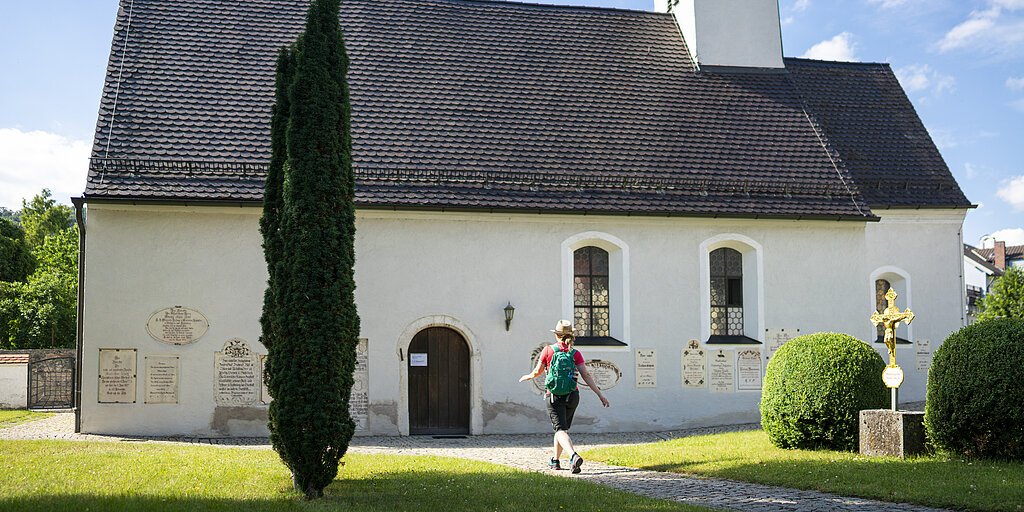
St. George's Church stands just outside of where Kipfenberg’s town wall used to be. You find it at the junction where the road to Eichstätt begins. St. George’s stands on the corner plot, surrounded by a low wall, just across from our Goat Fountain, or Goaßbrunnen. Entering through either of the wrought-iron entrance gates and walking toward the church’s entrance, the first thing you notice are the stone tablets embedded in the church walls. These are the gravestones of important prince-bishop officials, and important Kipfenberg citizens, who were buried here in the cemetery which used to surround the church. In the yard, you also find memorial stones dedicated to priests and nuns who served in Kipfenberg. The cemetery, established in 1616, was abandoned in 1859. A new cemetery was opened farther out of town, in the direction of Eichstätt, at the so-called Galgenleite, which was Kipfenberg’s old execution site. That cemetery is still used today. Thankfully, the execution site is not!
Origin
Nothing is known for sure about the origins of the church; but it probably dates back to the early Middle Ages, to the Gothic or Romanesque period. We do know that St. George’s was Kipfenberg’s first parish church and that, in the 15th century, it lost this distinction to the larger Church of the Assumption of Mary. There are only vague details about this in the documents which have survived. In 1592, St. George’s church was fundamentally expanded and rebuilt. Today, the building's exterior presents a few unevenly placed, rounded-arched windows and a sanctuary facing north. A relatively small entrance is set in a doorframe with a rounded arch made of natural stone.
The Interior
With its wooden ceiling and floorboards, the interior has an almost homey feeling. The rather simple interior lacks a pulpit and a sacristy, but in the early 17th century, a gallery was added at the rear. Dr. Elmar Ettle, our local historian, aptly describes the character of the church, noting that visitors feel welcomed by the honest simplicity of the space, giving the church, to those who enter it, a feeling of “home”. This is where people can bring their worries and needs, and where they find those who listen: the saints, their friends, and intercessors before God. The high altar was donated in 1628. The current altarpiece is an early Baroque structure from around 1700. Here we see again, flanked by two Corinthian columns, the church's namesake, St. George. In customary fashion, we see him on horseback, slaying a dragon. On the side altar to the left, we have an extraordinary Renaissance work of art from 1617. The stone sculptures depict, from the left, Saint Rochus, Saint Sebastian and, once again, St. George in what is probably the oldest sculpture in the church. This statue, dating from around 1470, is a relatively unusual depiction of the saint. We see him here as a young soldier in armor, standing on a dragon. It is not known who created this work, we only know that it was created by an artist from Eichstätt. The side altar to the right was donated in 1692 and is dedicated to the Virgin Mary. This altar's original image now hangs on the side wall to the right. In a very rare depiction, created between 1725 and 1750, the Madonna is shown here wearing a tiara. This picture was moved to its present location around 1890, after the right-hand altar was converted into a Lourdes grotto, where we now have a Madonna of the Crescent Moon. A special feature of St. George’s Church is a small, single-keyboard Baroque organ, located upstairs, at the rear of the church. Built in 1732 by the Nuremberg organ builder, Adam Ernst Reichardt, it is likely the only surviving small organ from that workshop. A detailed church guide, with a description of the sacred interior and facts about the building's history, is available in the church and at the tourist information office. The church is open and freely accessible during the day and during services.
vorherige Station nächste Station