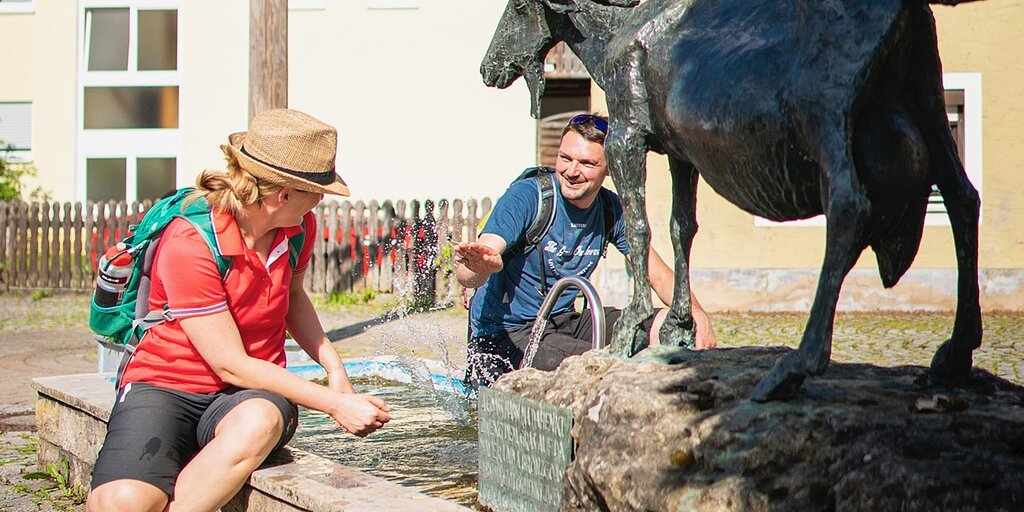
Symbol of Kipfenberg’s nickname
Kipfenberg’s Goaßbrunnen, or Goat Fountain, is located at the beginning of the Eichstätter Straße, at the junction with the Bachgasse and just across from St. George’s Church. A rectangular water basin houses the actual fountain, and hanging over one end of the basin is a heavy boulder of Jurassic dolomite. Standing on top is a roughly life-sized bronze goat. Created by the artist, Professor Erich Koch, it was cast at the Munich Academy of Fine Arts and has been standing here since April 4, 1969.
The Goat and the Goat Henker
You must be wondering why on earth we chose a goat to decorate our fountain! Well, like many communities in the Altmühl Valley, the people of Kipfenberg have to put up with a unique nickname – in our case, we are called "die Goaßhenker." In our dialect, a “Goaß” is a goat, and a “Henker” is a hangman. So, simply translated, a Goaßhenker is someone who hangs goats by the neck! The plaque on the boulder beneath the goat gives us a first hint about our nickname’s origins. In English, it reads: "We hanged a goat because of the grass on the wall and gave you a bronze goat because of our Goasshenka grief." Now, that is not really a satisfying explanation. In 1966, the "Kipfenberger Marktfrauen", a group of women who perform traditional dances on special occasions, donated the larger plaque you see above the fountain. On this plaque, we have a shortened version of a story Karl Kugler told in his book, “Die Altmühlalp”, published in 1868. Kugler’s original telling was as follows: “There had been peace in the country for a long time, so the people of Kipfenberg had not been on the town’s wall for quite a while. Then, they were amazed to see that lovely grass was growing on top of the wall (it was a very thick wall), and they thought it would be delicious food for a goat. After much argument, it was decided that a goat should be pulled up onto the wall to eat the grass. No sooner said than done. A rope, which had been secured at the top, was placed around the neck of a goat, and the people hoisted the goat with all their strength. This strangled the animal, but when some of the people saw its tongue hanging out of its mouth, they cried out joyfully: ‘She likes the grass’. But the goat did not eat, and upon closer inspection, they saw it was dead.” Kugler reported another possible source of the nickname, which he considered less likely, but who can really say? Kugler wrote: "In the former granary, there was a picture on a wall depicting a tailor trying to toss a dead goat over the town wall, but his buttonhole was caught in the animal's horn, leaving the goat hanging on the outside of the wall and the tailor on the inside.” While this picture might have given rise to the nickname, Kugler thought it was also possible that the picture was simply a pictorial representation of an already existing nickname, rather than its source. In fact, we don’t really know exactly how we got our nickname!
Not an Easy Decision
The decision to erect our fountain was not an easy one for Kipfenberg’s town council. The project was met with considerable criticism. In the Eichstätter Kurier of July 30, 1968, Hubert Hopfner reported the following: "Thankfully, it is impossible to count how many offensive complaints have been made in the town regarding Kipfenberg’s first ornamental fountain, even calling it a 'completely useless piece of junk..." Hopfner, an honorary citizen of Kipfenberg, did support the fountain, calling it "long overdue". He expressed respect for the council's courage and criticized the lack of a sense of humor among some of his fellow citizens. On December 30, 1968, at the last town council meeting of the year, the commissioning of the fountain was finally approved. And thanks to generous donations, the town had to raise just 1,000 of the 7,000 Marks required for the bronze casting. After the goat was finally in place, some people began to complain again. In May of 1969, our then Mayor Haderer had to address the issue once again at a town meeting. The mayor asked the well-known and highly respected Kipfenberg artist, C.O. Müller, to speak at the meeting. The Eichstätter Kurier later reported as follows: "He (meaning C.O. Müller) described the goat as an outstanding work of art, abstract enough to still be considered a successful work a hundred years from now. Anyone who wanted to have a goat that looks like the ones we see grazing about would have to take a real animal and stuff it. But then it would no longer be a work of art. Nature only provides the inspiration, while the artist's hand must bring out the essential and ignore the unessential..." The unrest soon subsided, and the Goaßbrunnen has become an integral part of Kipfenberg. Several times a year, it is the center of delightful events, for example, the Trachtenverein’s dance around the Maypole on the first of May and the traditional glass of beer enjoyed on a Sunday morning in August, during the Limes Festival. So, the annoyances of the early days have been forgotten, and over the years, the goat has become a symbol of Kipfenberg, showing up in some gardens and other places in town.
vorherige Station