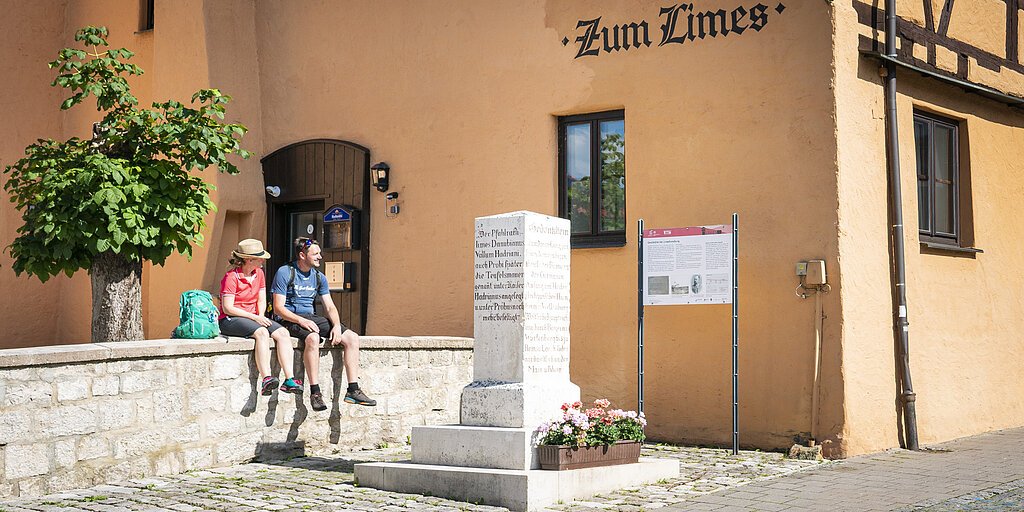
Erected under King Max II to commemorate the Roman Limes
The Memorial Stone
The word "Limes” is encountered quite frequently in Kipfenberg. There is a Limes Trail, a Limes Inn, a Limes Festival, and even a Limes Queen. So, you may be wondering what the "Limes" is and why the name appears so often in our area. We begin our search for the answer at a spot where we encounter the word several times, namely, at the northern exit of the market square, directly behind the Limes Inn. Here, near the junction with the Limesweg, stands the Limes Gedenkstein, or Memorial Stone – a square column on a low stepped base, erected in 1861 under King Max II of Bavaria. On each of its four sides, it bears inscriptions, carved into the stone and inked in color. On the front side, facing the road, it says: "Gedenkstein”, or "Memorial Stone", followed by "Boundary marker between the former Roman Empire and the Germanic people…Beginning at Haderfleck between Hienheim and Weltenburg… Primary western direction through Bavaria and Württemberg to Rems and Lorch…then northwest to the Main and Rhine rivers." So, we now know that the Limes was the boundary between the Roman Empire and the Germanic people. The other sides of the stone provide further details. On the right side, we read: "The path of the Limes crosses the Ingolstadt-Amberg state road near Denkendorf and continues past Pfahldorf, Hirnstetten, and along the Eichstätt-to-Greding road between Wachenzell and Herlingshart."The left side of the stone tells us who built the Limes: "The Limes along the Danube, Hadrian’s Wall, or Probi, later called the Devil's Wall, was built under the Emperor Hadrian, and further fortified under Probus."Finally, on the back of the stone, we read: "This memorial stone was erected under King Max II in 1861."
Course of the Limes in Kipfenberg
So, the Limes served as a fortification along the boundary between Roman and Germanic territories. Later, it was also called the "Pfahlrain", which means a boundary made with wooden stakes, thus explaining the origin of nearby place names such as Pfahldorf and Pfahlbuck. The location for this memorial stone was well chosen, as the Limes ran directly past this spot. We can better imagine this if we cross the road and look back at the memorial stone. Here, slightly to your left, you can see the Limesweg up to the Lutheran Church, ending where the forest begins. Having come down from the mountain and along the Limesweg, the border fortifications ran right past where you are standing. They then continued along the Försterstraße to your left before crossing the river near today's Altmühl Bridge. The Limes continued up the next hill, behind the school. From this mountain spur, known as "Pfahlbuck," the Limes continued toward Pfahldorf. So, some of the most important border fortifications of the Roman Empire in the 2nd and 3rd centuries AD ran directly through Kipfenberg as a part of what is known as the "Upper Germanic-Raetian Limes”.
The Devil's Wall
After the Alemanni invasion in 233 A.D., the Romans left our area, and the Limes gradually fell into disrepair. In time, its origins were even forgotten, and it became known as the mysterious "Devil's Wall". A number of historians have addressed this topic, including Johannes Aventinus, the so-called "Father of Bavarian Historiography". In the 16th century, he was one of the first scholars to study and document the Roman Limes in Bavaria. But a true understanding of the Limes and its history began in 1806, when Pastor Dr. Franz Anton Mayer was transferred to Gelbelsee, a town up near our castle. His extensive hikes along the Limes marked the beginning of the systematic exploration of the Bavarian section of the Limes, from the Danube to the Württemberg border. Mayer became a prominent Limes expert, and his writings laid the foundation for all subsequent research.
Imperial Limes Commission
Years later, in 1892, an "Imperial Limes Commission", under "Route Commissioner" Dr. Friedrich Winkelmann of Pfünz, resumed the systematic and scientific exploration of the Kipfenberg section of the Limes. Their work has provided us with a large part of what we know today about the Limes and about Roman life in the area around Kipfenberg. If you would like more detailed information, you can visit our Roman and Bajuwaren Museum located next to the Kipfenberg Castle. There, the "Limes Infopoint" features a unique exhibition on the topic of "Roman Life on the Limes.“ You can also visit a reconstructed Limes tower on the Pfahlbuck, the mountain spur on the left as you exit Kipfenberg heading towards Pfahldorf. From the street named Sonnenleite, a beautiful hiking trail leads you up, behind the school, to the tower. There you will also find an information board with more details about the "Limes in Kipfenberg". Thanks to a reconstructed palisade fence, you can also get a good idea of what the Limes looked like at that time.
vorherige Station nächste Station