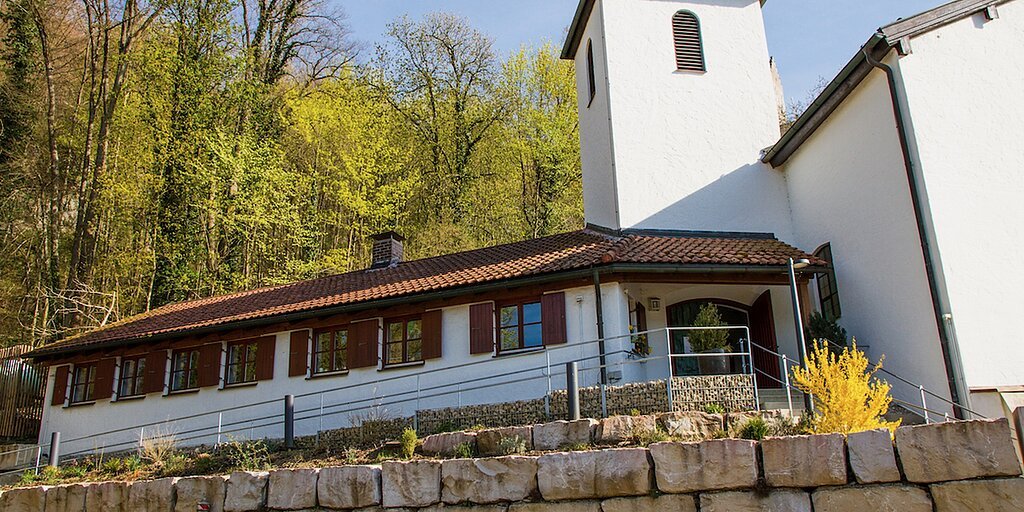
A Protestant Church with an Extraordinary History
The Beer Cellar
The Lutheran Christ Church in Kipfenberg and its location have an extraordinary history. The church was originally the hall of an inn, and the Limes, the Roman border fortification, ran directly through the property on which it stands. As early as 1631, the “Salbuch“, the official property and revenue registry of the town, records a "Keller am Schloßberg", or cellar on the castle hill, belonging to a Kipfenberg brewer. This was most likely a forerunner of the "Felsenkeller", or stone cellar, which the innkeeper Böll and his wife acquired in 1830. Included in the acquisition was a brewery property, the present-day "Limes" inn, just down the hill from here. Originally, an open wooden structure with a slate roof was built above the cellar and became known as the "Sommerkeller", or summer cellar. A skittles bowling alley, a shady beer garden under trees, and a nearby shooting range made it a popular venue. To ensure the venue could also be used during the colder months, the wooden structure was replaced, in 1880, by one of stone. This gave rise to the "Böllsaal," a ballroom in which a large part of Kipfenberg's social life took place in the years that followed. Over time, and after several changes of ownership, the beer cellar was closed in 1906, and the building stood empty. More than twenty years later, in 1929, Kipfenberg's first kindergarten was established in the former ballroom. After the kindergarten was later relocated, the ballroom was used to house prisoners of war, foreign workers, and war refugees. After that, the building gradually fell into disrepair. It had almost become a ruin when, on February 11, 1954, the Lutheran congregation in Kipfenberg acquired it for their future place of worship.
Conversion into a Church
So, the former summer cellar of a brewery was converted into a church. A bell tower was added to the side, with what was described as a "simple peal" from a bell foundry in Erding. Finally, after many years, the dream of Kipfenberg’s Lutheran congregation came true when their first church was dedicated with a grand celebration on May 13, 1956. The old beer cellar is still there, beneath the church, but the beer is gone! Nearly 30 years later, in July 1984, the church council began planning a suitable meeting and event space. The number of congregation members had continued to grow, and it became urgent to provide a suitable venue for other events, in addition to church services. It was not an easy project, as, in addition to problems during the planning phase, it was difficult to secure adequate funding. The congregation had to contribute their own share, which they were able to do with a so-called “Bausteinaktion”, or "building block campaign." For this purpose, cards depicting a building block were produced and sold – the idea, incidentally, of a vacationer who was staying in Kipfenberg at the time. Grants came from, among others, the town of Kipfenberg and from surrounding communities. The Bavarian Landeskirche, a regional union of Lutheran congregations, covered the majority of the costs. On January 13, 1987, the new parish hall, built onto the side of the tower, was opened and quickly became a much-used meeting place for community life.
The Church Interior
Inside the church, there are two artistic highlights. One is the organ, standing impressively in the center at the back of the church. Acquired in 1992, this organ is a very special piece by the organ builder, Anton Ehrlich, dating from 1864. With one keyboard, the organ has six registers and a separate console. The beautiful stained-glass windows are also an artistic highlight, created in 1992 by an Augsburg artist named Helmut Ulrich. The message behind the artistic design can be found in the minutes of a church council meeting of October 26, 1989: I quote: "At a time when more and more people know almost nothing about the Christian message, the idea is to create images of core themes of the Christian faith, images that are so vivid that even children can understand them, perhaps in the style of a children's Bible."
vorherige Station nächste Station